
By Peggy Pliscott, SMP Artist at Precision Scalp
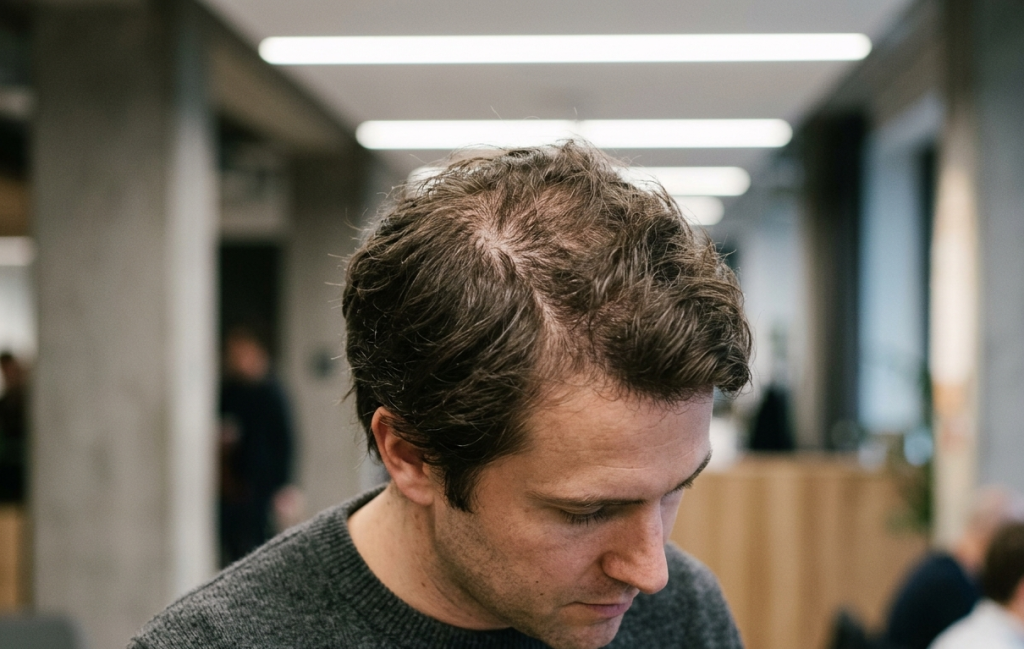
The crown is the hardest part of your head to get right with scalp micropigmentation. It catches overhead light at the worst possible angle, it has a natural spiral pattern most people never think about, and a single placement error is visible from almost every direction. These five density challenges are specific to the crown area, so you know exactly what to look for before committing to a procedure.
1. Overhead lighting exposes flat pigment immediately
The crown sits at the top of your head, which means it takes the full force of overhead lighting: office fluorescents, restaurant downlights, direct sunlight. Flat, uniform pigment placement reads as artificial under that kind of light because natural hair never grows in a perfectly even grid.
In the scalp micropigmentation crown area, skilled practitioners vary the depth, size, and spacing of each impression to create light-catching irregularity. That variation is what makes density look real rather than painted on. Ask your artist to show you healed crown work photographed under direct overhead light, not just flattering side-lit portfolio shots.
2. The natural whorl pattern must be mapped before a single dot is placed
Almost every man has a whorl at the crown: a point from which hair radiates outward in a spiral. Ignoring it is one of the most common mistakes in crown hair tattoo work. Pigment placed without following that spiral sits against the grain of your existing hair and looks wrong, even to people who can’t articulate why.
Before treatment begins, the whorl centre should be identified and mapped, and every impression should radiate from that point in the correct direction. If you still have any existing hair at the crown, the SMP impressions need to follow those follicle angles precisely. This takes time, but it’s non-negotiable for a natural result.
3. Density must be built gradually across a minimum of three sessions
Crown SMP for male density requires a minimum of three sessions, and sometimes four depending on the level of thinning. Trying to pack full density into a single sitting risks pigment blowout, where impressions spread and merge under the skin, creating grey blotches rather than crisp follicle dots.
Each session builds on the last. The first lays a foundational layer at lighter density; subsequent sessions deepen and refine, allowing the practitioner to assess how the pigment has healed and calibrate the next pass accordingly. Rushing this process is the single fastest route to a result that needs correction work.
4. Pigment tone selection is more critical at the crown than anywhere else
Because the crown is so visible from above, any mismatch between pigment tone and your existing hair colour is immediately obvious. This is especially true for men with lighter brown or salt-and-pepper hair, where a pigment that reads too dark creates a harsh, unnatural contrast against the scalp.
A well-chosen tone in the scalp micropigmentation crown area should sit slightly lighter than your actual hair colour when first applied, because pigment deepens as it heals. Getting this calibration right requires an artist who understands how specific pigment formulations behave over time, not just how they look on application day.
5. The transition from treated to untreated areas needs a feathered edge
Where the SMP crown density treatment meets your natural hair at the sides and back, the boundary needs to disappear, not announce itself with a visible line. A hard edge in that transition zone is one of the most tell-tale signs of inexperienced work, and it’s particularly difficult to correct without starting over.
Feathering involves gradually reducing the density of impressions as you move outward from the centre of the treated area, so the result blends seamlessly into your existing hair. This requires precise spatial awareness and a steady hand. Look specifically for examples of feathered transitions in a practitioner’s healed portfolio before making any decision.
The crown is unforgiving, but it’s absolutely treatable when the work is approached correctly. Understanding these five challenges puts you in a far stronger position to evaluate practitioners, ask the right questions, and set realistic expectations going into your sessions.
Frequently Asked Questions
How many sessions does crown SMP typically require?
Crown SMP for male density requires a minimum of three sessions, and some clients need a fourth depending on the extent of thinning. Sessions are spaced to allow proper healing between each pass, which is essential for building realistic density without pigment blowout or over-saturation in the treated area.
Will SMP at the crown look natural under bright light?
When done correctly, SMP in the crown area holds up well under overhead and direct lighting. The key is varied impression size and spacing: uniform placement looks artificial under harsh light. Ask any practitioner you’re considering for healed crown results photographed under direct overhead light before committing to treatment.
Does scalp micropigmentation work for men who still have some hair at the crown?
Yes. Male density SMP is specifically designed for men with thinning hair who prefer not to shave. The impressions are placed to match your existing follicle angles and blend with remaining hair, adding the appearance of fuller density rather than creating a shaved-head look.
What makes crown SMP more difficult than other areas of the scalp?
The crown presents three specific challenges: it receives direct overhead light that exposes flat or unvaried pigment, it has a natural whorl pattern that must be followed precisely, and it requires a seamless transition into surrounding hair. Any error in these areas is visible from multiple angles, making practitioner skill especially critical.
How long does SMP crown density treatment last?
SMP crown density results typically last between four and six years before a colour refresh is needed, though this varies with skin type, sun exposure, and aftercare. The pigment gradually lightens over time rather than disappearing abruptly, so most clients find a single maintenance session every few years keeps the result looking sharp.