
By Peggy Pliscott, SMP Artist at Precision Scalp
You want to look like you chose to shave your head, not like you lost a battle with hair loss. That is the specific promise of the shaved head style of scalp micropigmentation, and it is worth knowing exactly what it delivers before you commit. This article covers the healed result in precise terms: what the dots look like, how the hairline is shaped, how long it lasts, and who this style genuinely suits.
What the healed result actually looks like
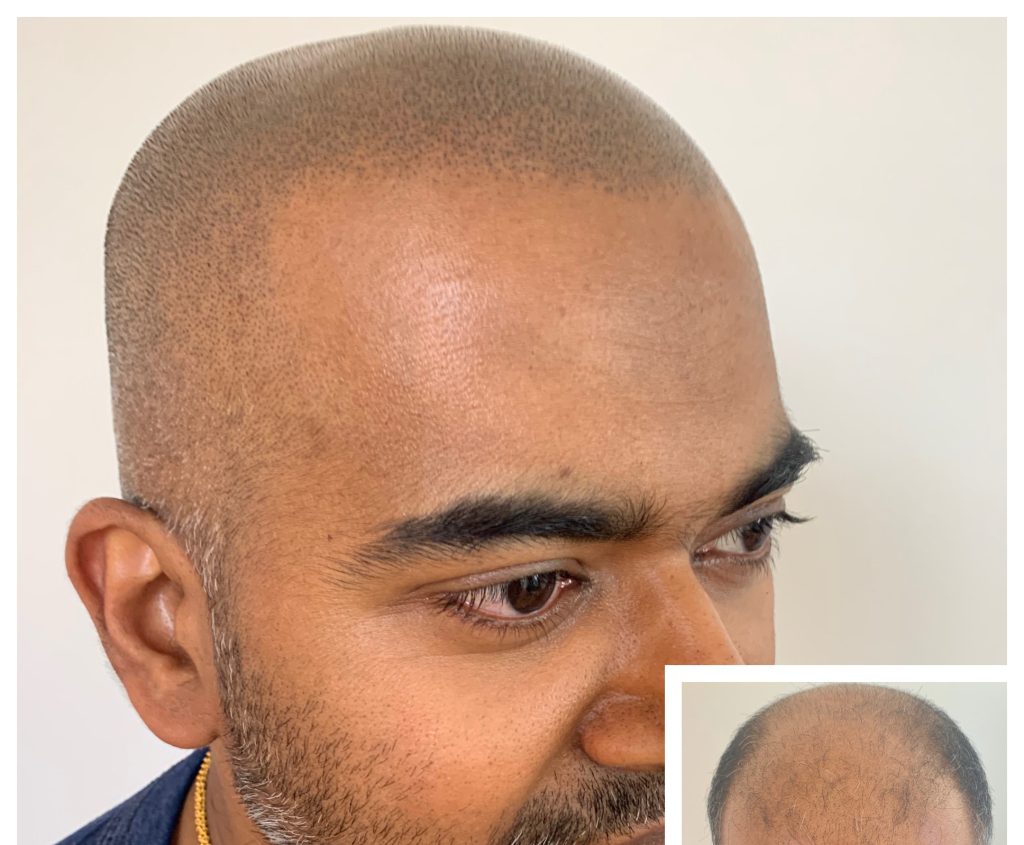
Scalp micropigmentation for the shaved head look creates the visual impression of closely cropped hair follicles across the scalp. Medical-grade pigment is deposited at a depth of roughly 1.5 to 2 millimetres into the dermis using a technique called stippling or pointillism. Each dot is placed to replicate the flat, circular cross-section of a freshly razor-shaved hair shaft sitting at skin level.
Dot density builds progressively across sessions. Early sessions typically deposit around 40 dots per square centimetre. By the final session, that figure reaches 80 to 100 dots per square centimetre in areas requiring full coverage. A single session can place over 40,000 individual pigment dots. That level of density is what makes the finished result read as a cropped head of hair rather than a stippled pattern.
Needle selection matters more than most people realise. A 0.2 mm single-point needle is used along the hairline border to keep the edge precise and natural. Wider coverage areas, including the vertex, temporal, and occipital zones, use a 0.25 mm triple-point needle for efficient, even density. The pigment colour is matched to your natural hair tone and skin undertone so that the dots sit credibly against your complexion rather than appearing flat or grey.
How the hairline is designed for this style
The shaved head style uses a soft, irregular hairline rather than a hard geometric edge. A sharp, perfectly straight hairline reads as artificial even from a short distance. A well-executed SMP hairline has micro-level irregularity, with individual dots placed just outside a defined boundary to soften the transition between pigmented scalp and bare skin.
Hairline placement is one of the most consequential decisions in the entire process. It is shaped around your facial structure, your age, and what genuinely suits your proportions. A good approach to hairline design mirrors the thinking behind photographic composition: the frame must work for the subject. A hairline that sits too low, or that follows a template rather than your actual face, will look wrong even if the pigment itself is flawless.
For the shaved style specifically, the hairline is kept conservative and realistic. It does not mimic a 22-year-old’s low, full frontal line if that is not what you had. It creates a plausible, flattering boundary that frames the face at the right height for your age and features. That honesty in design is what separates results that age well from those that look dated within a few years.
Who this style suits and who it does not
The shaved head look works best on clients who already shave or closely crop their hair, or who are comfortable committing to that maintenance. SMP does not replicate a full head of longer hair. It replicates the look of a number-zero to number-one shave. If you are hoping to keep some length, a hair density SMP approach is the more appropriate technique.
Candidates who see the strongest results include men with male pattern baldness at any Norwood stage, clients with alopecia areata or alopecia totalis, and those with scalp scarring from previous hair transplant surgery. Scalp scars and strip donor sites in particular respond well, as the pigment visually integrates the scar tissue into the surrounding replicated follicle pattern. Hair loss related to chemotherapy is another indication where this style delivers meaningful results.
Contraindications are worth knowing. Active acne, psoriasis flare-ups, eczema on the scalp, and keloid-prone skin all require a thorough consultation before proceeding. These do not automatically rule you out, but they affect timing and technique. Oily skin and high sun exposure also accelerate fading; if either applies to you, consistent SPF 30 to 50 application after healing is non-negotiable for longevity.
Realistic expectations for longevity and touch-ups
The shaved head SMP result typically holds well for three to five years before a touch-up becomes worthwhile, though results lasting up to eight years are documented. Fading is gradual and even rather than patchy. The mechanism is straightforward: epidermal pigment clears within roughly 27 days via natural skin turnover, while dermal pigment persists but slowly disperses due to sun exposure, immune activity, and ageing skin. You will not wake up one morning and notice it has gone. It simply softens over time.
Most clients complete the shaved head look in two to four sessions, each spaced several weeks apart. Each session lasts between one and five hours depending on coverage area. Touch-up sessions every three to four years keep the contrast crisp and the hairline sharp. The total cost reflects session count and coverage area, so a full-coverage shaved head treatment is priced differently to a smaller scar camouflage session.
Aftercare in the first ten days is specific and important. For the first four days: no water on the scalp, no shampoo, no sweating, and no shaving. From day five to ten: gentle washing is fine, but keep direct sun off the scalp. From day ten onwards: SPF applied to the scalp becomes a daily habit, and normal grooming resumes. Avoid swimming pools for 28 days after your final session. Full healing takes approximately 30 days, which is also when the settled, healed result becomes visible.
Frequently Asked Questions
How many sessions does the shaved head SMP style require?
Most clients complete the shaved head look in two to four sessions, each spaced several weeks apart. The exact number depends on coverage area, scalp tone, and how the pigment settles after each session. A full assessment at consultation will give you a more precise projection based on your specific hair loss pattern and skin type.
Will shaved head SMP results look natural on my skin tone?
Yes, provided the pigment colour is correctly matched to your natural hair tone and skin undertone. Shaved head SMP results depend heavily on this match. Pigment that sits too dark or too cool against your complexion reads as artificial. A skilled practitioner selects and blends pigment shades to ensure the replicated follicle dots sit credibly and naturally against your scalp.
How long does the shaved head SMP result last before fading?
Shaved head SMP results typically last three to five years before a touch-up is recommended, though well-maintained results lasting up to eight years are documented. Fading is gradual. Sun exposure, oily skin, and faster cellular metabolism all accelerate the process. Daily SPF 30 to 50 on the scalp after healing is the single most effective way to extend longevity.
Can SMP cover a hair transplant scar to match the shaved head look?
Yes. Scalp micropigmentation is one of the most effective ways to camouflage strip donor scars and follicular unit extraction scarring from previous hair transplant surgery. Replicated follicle dots are placed across and around the scar tissue to visually integrate it into the surrounding scalp, making it indistinguishable when the head is shaved or closely cropped.
What should I look for when searching for SMP near me?
When searching for SMP near me, prioritise practitioners with a documented portfolio of healed shaved head results, not just fresh post-treatment photographs. Healed results show true pigment colour, dot clarity, and hairline precision at 30-plus days. Check for bloodborne pathogen certification, a sterile clinic environment, and a consultation process that involves hairline design specific to your facial structure.