
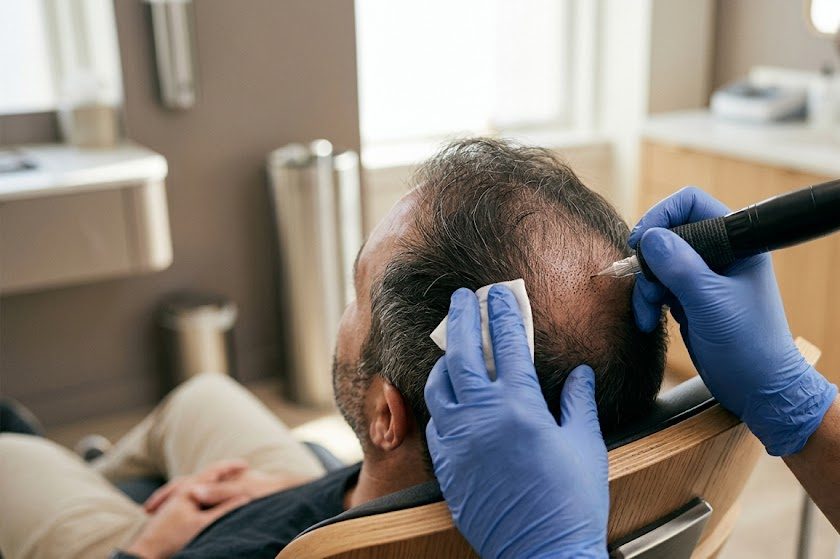
By Peggy Pliscott, SMP Artist at Precision Scalp
You have committed to the sessions, you have sat in the chair, and the density difference is already visible. What happens in the next 30 days will determine whether that result lasts three years or six. This article covers the exact aftercare protocol for male density SMP, day by day, so you know precisely what to protect and why.
The first 72 hours: the window that matters most
In the immediate hours after a density session, the pigment dots deposited into your scalp are sitting at the epidermal and upper dermal interface. They have not fully settled. The surrounding tissue is mildly inflamed, pores are open, and the skin is more permeable than usual. This is when the rules are strictest, and breaking them has the most direct consequences.
For the first four days, keep water completely off your scalp. That means no showering over your head, no shampoo, and no rain exposure unless your head is covered. It also means no sweating. A hard gym session, a sauna, or even a brisk walk on a warm day can push moisture through the scalp and displace pigment before it has anchored. Your SMP artist is not being overcautious when they tell you this. Epidermal pigment that has not bonded can clear within roughly 27 days even under ideal conditions; early moisture exposure shortens that window significantly.
Avoid shaving for at least four days after the session. The blade creates micro-abrasions across the treated area, and any friction on fresh pigment dots risks pulling them out before they have set. If you normally keep a very close shave, plan your sessions around this.
Days five to thirty: protecting the pigment as it heals
From day five, you can introduce gentle washing with a mild, fragrance-free shampoo. Use light pressure only, with no scrubbing and no harsh exfoliants. The scalp will look slightly faded during this period, which is normal and expected. The outer epidermal layer sheds as it heals, and some surface pigment goes with it. What remains in the dermal layer is what defines your long-term result. Do not be alarmed by the temporary fade; it is part of the process.
Sun exposure is a serious concern from day one through to the end of your healing period and beyond. UV radiation is one of the primary drivers of pigment breakdown over time. It accelerates the immune activity that gradually disperses dermal pigment and speeds up the cellular turnover that clears it from the epidermal layer. During days five to thirty, keep your scalp covered outdoors or stay out of direct sun entirely. After the 30-day mark, daily SPF 30 to 50 applied to the scalp becomes part of your ongoing routine, not an occasional precaution.
Swimming pools are off limits for the full 28 days after your final session. Chlorinated water is particularly aggressive on fresh pigment, and even treated water after day five can interfere with healing. Saltwater carries the same risk. If you swim regularly, factor this into when you book the final session of your series.
Why male density SMP requires at least three sessions
A male density procedure is not completed in one sitting. The minimum is three sessions, with a fourth sometimes added depending on the degree of thinning and how your skin responds. There is a clinical reason for this: pigment dot density is built progressively, starting at around 40 dots per square centimetre in the first session and increasing to 80 to 100 dots per square centimetre by the final session. Attempting full density in a single appointment would overload the tissue and produce a flat, unnatural result rather than the layered, three-dimensional look that makes the treatment effective.
Each session is spaced several weeks apart, which also gives your practitioner the opportunity to assess how the pigment has settled, adjust tone where needed, and refine the hairline or crown coverage. Your aftercare between sessions directly affects what the next session is building on. If you have been inconsistent, perhaps too much sun, a gym session on day three, or scrubbing during washing, the canvas your artist is working on is compromised, and it takes longer to reach the target density.
How aftercare connects to longevity and when you will need a touch-up
Male density SMP results typically last three to six years before a touch-up is needed. That range is not arbitrary. It reflects real differences in how men’s skin ages, how much sun exposure they accumulate, and, crucially, how well they follow aftercare in the weeks after each session and the months that follow.
Men with oily skin and faster cellular metabolism tend to see fading at the earlier end of that range. Men with drier or more mature skin, and those with a consistent SPF habit, often push well past five years. Factors outside your control, such as genetics and certain medications, also play a role. But the variables you do control are significant.
When fading does occur, it is gradual and uniform rather than patchy, which means a touch-up session restores the result without starting from scratch. Most men return every three to four years for a maintenance visit. Thinking of it in those terms reframes the investment: you are not paying for something that wears out, you are maintaining something that works continuously. The SPF habit, the careful washing routine, the avoided pool sessions, these are not inconveniences. They are the difference between a three-year result and a six-year one.