
By Peggy Pliscott, SMP Artist at Precision Scalp
You have accepted the hair loss and you are ready to do something about it. Scalp micropigmentation is on your shortlist, but now you are staring at a dozen clinics and wondering how to tell a great practitioner from a risky one. This guide gives you five concrete criteria to apply before you book, so you walk into your consultation already knowing the right questions.
1. Verify the clinic’s classification in your state
Licensing for medical micropigmentation in the United States is fragmented. There is no single federal standard, and states classify the procedure differently: some treat it as body art, some as cosmetic tattooing, and a handful place it under a broader aesthetics or cosmetology licence. What matters is that your practitioner holds the correct credential for their specific state.
Ask to see their current licence and whether they hold bloodborne pathogens certification. Reputable practitioners should also have registration with a recognised professional body, such as the American Academy of Micropigmentation. If a clinic cannot produce documentation on request, that is your answer before you have spent a cent.
2. Study healed results, not fresh ones
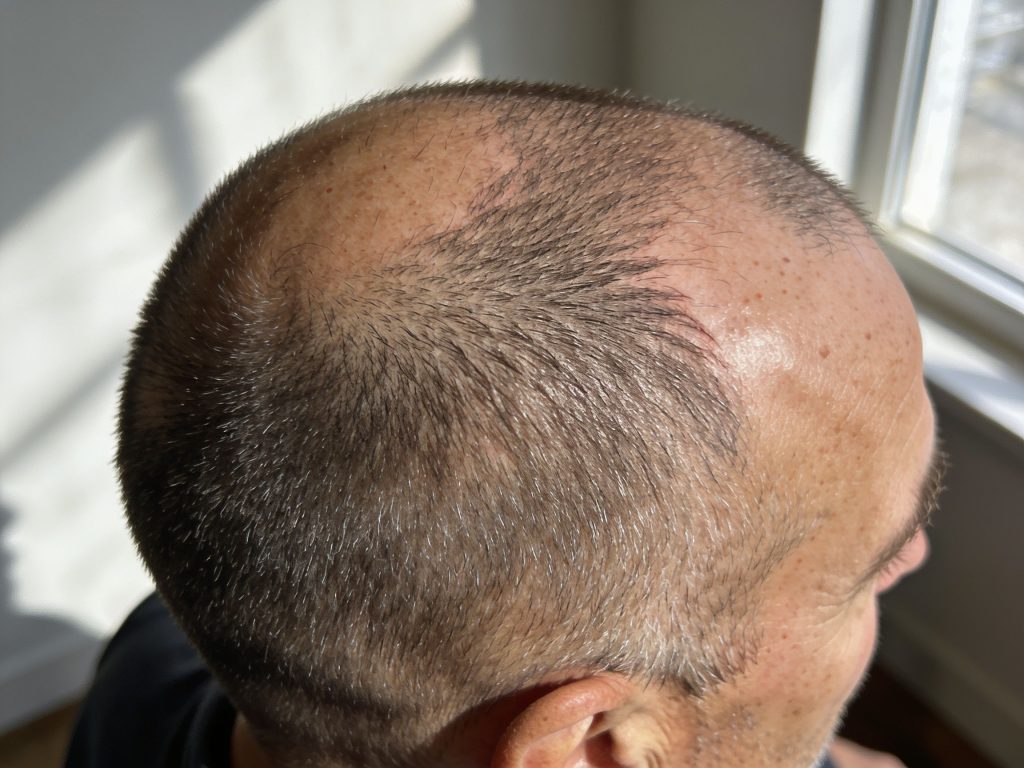
Fresh SMP work looks bold and dark. The real test is what it looks like thirty days after the final session, once the scalp has fully healed and the pigment has settled. Ask specifically for healed portfolio images of male density work, not the straight-razor, close-shaved look if that is not what you are after.
For density treatment, pigment dots need to sit at varying depths, typically 1.5 to 2 millimetres into the dermis, to blend convincingly with your existing hair rather than sit on top of it like a flat shadow. Look for natural-looking variation in dot size and spacing. If every photo in a portfolio looks identical or overly uniform, the practitioner may lack the technique to adapt to different scalp tones and hair textures.
Pigment dot density is progressively increased across sessions, starting at around 40 dots per square centimetre and building to 80 to 100 in the final sessions. A healed portfolio should show that build-up without the result looking patchy or over-saturated in any one area.
3. Understand the session structure before you commit
Male density SMP always requires a minimum of three sessions, and a fourth may be needed depending on your coverage area, scalp characteristics, and how well your skin retains pigment. Anyone quoting a single-session result for density work is cutting corners, and the outcome will show it.
Sessions are spaced several weeks apart to allow healing between each pass. This is not filler time: it is when the practitioner assesses how your scalp has retained pigment and adjusts dot density accordingly. Oily skin, certain medications, and faster cellular metabolism can all affect retention and may push you towards that fourth session. Ask the clinic how they structure their session plans and what factors would trigger a fourth appointment.
4. Know the realistic price range for your region
SMP for male density in the United States typically ranges from around $1,500 to $4,000 for a full course, though costs vary significantly by location, practitioner experience, and coverage area. Clinics in major metropolitan areas such as New York, Los Angeles, and Chicago tend to sit at the higher end. Smaller markets may offer lower entry points, but price should never be your primary filter.
When comparing costs, ask for the total price broken down by session count rather than a single lump figure. Touch-ups are typically needed every four to six years, so factor that into your long-term thinking. Insurance does not cover the procedure. A clinic that leads with a suspiciously low headline price but adds costs at each session is one to approach with caution.
5. Ask these four questions at your consultation
A good consultation tells you as much about a practitioner’s character as it does about their technical skill. Go in with these four questions and listen carefully to how they are answered.
- Can I see healed before-and-after images of clients with a similar hair loss pattern and skin tone to mine? A practitioner with genuine depth of experience will have these readily available.
- What needle configuration do you use for density work versus hairline refinement? The correct answer involves a finer, single-point needle for borders and a multi-point needle for the vertex and crown. Vague answers here suggest limited technical knowledge.
- How do you handle pigment fading, and what is your touch-up policy? Fading is normal and expected; scarring alopecia fades faster than androgenetic cases. A practitioner who implies that pigment is permanent is not being straightforward with you.
- What aftercare protocol do you provide? The first four days require no water, shampoo, sweating, or shaving on the scalp. From days five to ten, gentle washing is fine but sun exposure should be avoided. From day ten onwards, SPF 30 to 50 on the scalp is essential. If the clinic’s aftercare instructions do not broadly match this, question their training.
The right SMP clinic for male density work will not simply have impressive photos. It will have a practitioner who explains the process clearly, documents their credentials, and sets honest expectations about sessions, healing, and longevity. That combination is what separates a result you will be proud of five years from now from one you will be looking to correct.
Frequently Asked Questions
How many SMP sessions do I need for male density treatment?
Male density scalp micropigmentation requires a minimum of three sessions, with a fourth session possible depending on your scalp’s pigment retention, coverage area, and skin type. Sessions are spaced several weeks apart, allowing the practitioner to assess healing and progressively build pigment dot density from around 40 dots per square centimetre up to 80 to 100 in the final pass.
How do I find a qualified SMP clinic in the United States?
Start by confirming the practitioner holds the correct state licence for medical micropigmentation or cosmetic tattooing, alongside bloodborne pathogens certification. Ask to see healed portfolio images of male density work specifically, and check whether they have professional registration with a body such as the American Academy of Micropigmentation. Credentials and healed results are your two most reliable filters.
What does SMP for male density cost in the United States?
A full course of scalp micropigmentation for male density typically costs between $1,500 and $4,000 in the United States, varying by region, coverage area, and practitioner experience. Major cities such as New York, Los Angeles, and Chicago tend to sit at the higher end. Ask for a total cost broken down by session count, and budget for a touch-up appointment every four to six years.
How long does SMP for male density last before a touch-up is needed?
Scalp micropigmentation results for male density typically last four to eight years before fading requires a touch-up. Fading occurs through natural epidermal turnover, sun exposure, and immune activity on dermal pigment. Regular SPF 30 to 50 application, a dry skin type, and avoiding prolonged sun exposure all support longer-lasting results. Touch-up appointments are usually single sessions rather than a full course.
What aftercare is required after each SMP density session?
For the first four days after each session, avoid water on the scalp, shampoo, heavy exercise, sweating, and shaving. From days five to ten, gentle washing is permitted but keep the scalp out of direct sun. From day ten onwards, apply SPF 30 to 50 daily and avoid swimming pools for the first 28 days. Full healing takes approximately 30 days after the final session.