
By Peggy Pliscott, SMP Artist at Precision Scalp
You’re researching hair tattoo artists and you’ve quickly realised that not everyone producing results online is producing good ones. What separates an exceptional SMP artist from one who’ll leave you with regrets comes down to a few specific, assessable factors. By the end of this article, you’ll have a clear, practical checklist to evaluate anyone before you commit.
Why artist quality varies so dramatically in SMP
Scalp micropigmentation sits in an unusual position. It looks deceptively simple from the outside, which means the industry has attracted practitioners with wildly different levels of training, artistic ability, and technical precision. A hair tattoo is permanent. The stakes are high.
The technical side involves specialised pigments, needle configurations, and pressure control that differ fundamentally from conventional tattooing. An artist who crosses over from body art without specific SMP training is working with the wrong framework from day one. The result tends to be dots that are too large, too deep, or too dark, and they age badly.
What elevates the best SMP artists isn’t just technical competence. It’s an eye for aesthetics: specifically, the ability to design a hairline that looks like it belongs on your face, at your age, with your bone structure. That combination of technical precision and artistic judgement is rare, and it’s exactly what you should be screening for.
How to assess a portfolio with real scrutiny
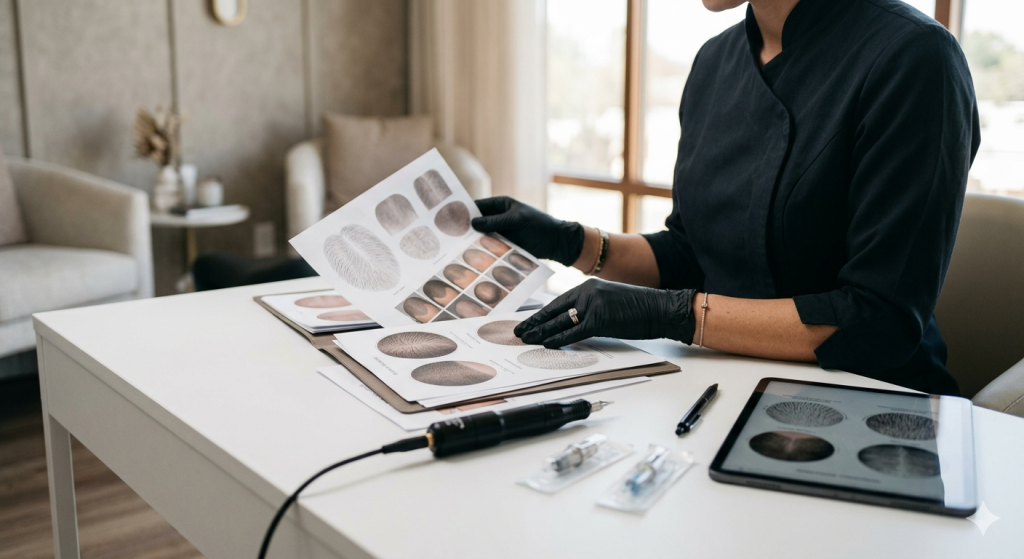
Every practitioner has before-and-after photos. The question is what those photos actually tell you. Fresh results, shot in flattering light immediately after a session, can look convincing from almost any artist. What you want to see are healed results, photographed in natural light, at least eight to twelve weeks after the final session.
Look specifically at dot size and consistency. The individual impressions should be small, uniform, and closely matched to natural follicle scale. If you see blotchy patches, variation in size, or areas where the pigment has spread or blurred, that’s a sign of poor technique or incorrect pigment depth.
Hairline design is the other critical element. For a shaved-style hair tattoo, the front hairline must look natural: slightly irregular, age-appropriate, and proportionate to the client’s face. A hairline that sits too low, runs too straight, or looks like a solid line rather than a soft edge will read as artificial from across the room. Top hair tattoo practitioners understand this instinctively, and their portfolios reflect it.
Certification, training lineage, and why both matter
There is no single universal governing body for SMP, which makes this area confusing. Certification from a reputable, specialist SMP training programme still matters, though. It tells you the artist has been formally assessed on technique, pigment knowledge, skin science, and aftercare protocol.
Training lineage is worth asking about directly. Where did the artist train? Who taught them? Practitioners who trained with founding or senior figures in the field bring a deeper understanding of the craft than those who completed a weekend course and set up immediately. It’s a reasonable question, and a confident, skilled artist will answer it without hesitation.
Experience level compounds everything. An artist with hundreds of completed hair tattoo clients has encountered a wide range of skin types, scalp conditions, and hairline challenges. That breadth of experience shows up in their ability to problem-solve and personalise. Ask how many SMP procedures they’ve completed, and ask to see examples from clients whose starting point looks similar to yours.
Questions worth asking before you book
A consultation is your opportunity to assess the artist as much as the procedure. Pay attention to how they talk about hairline design. Do they take measurements? Do they consider your facial structure, age, and how the result will look in ten years? A practitioner who immediately starts drawing a line without that conversation is skipping the most important part of the process.
Ask what pigment system they use and why. Ask about their needle selection for the shaved style specifically. Ask what happens if you want adjustments or a touch-up after the treatment settles. Evasive or vague answers to these questions are a signal worth taking seriously.
The best SMP artists are transparent about the process, realistic about outcomes, and confident enough in their work to show you exactly what you’re getting. They inform rather than sell. That distinction matters more than any marketing claim you’ll read on their website.
Frequently Asked Questions
What qualifications should the best hair tattoo artists have?
The best hair tattoo artists should hold certification from a recognised SMP-specific training programme and be able to clearly explain their training lineage. Formal SMP certification demonstrates assessed competence in technique, pigment science, and skin anatomy, which is a meaningfully different skill set from general tattooing or cosmetic work.
How many sessions does a shaved-style hair tattoo typically require?
A shaved-style SMP hair tattoo typically requires two to three sessions. Each session builds density and refines the result, with the final appearance assessed after the pigment has settled and healed. Your practitioner should discuss the expected number of sessions with you during the initial consultation, based on your specific scalp and goals.
What does a poor-quality hair tattoo look like?
Signs of poor-quality SMP include dots that are too large, blurred, or inconsistent in size, as well as a hairline that sits too low, runs too straight, or creates a harsh edge rather than a soft, natural transition. Pigment that has turned blue or green after healing also indicates incorrect pigment depth or an unsuitable pigment formula.
Can I trust a hair tattoo artist who has crossed over from conventional tattooing?
Not automatically. Conventional tattooing uses different needles, pigments, and depth principles to SMP. An artist who has crossed over without completing dedicated scalp micropigmentation training is working with the wrong technical framework. Specific SMP certification and a strong portfolio of healed results are non-negotiable, regardless of their tattooing background.
How do I evaluate a portfolio when researching top hair tattoo practitioners?
Focus on healed results photographed in natural light, not fresh work shot in a studio. Look for small, consistent dot size, clean pigment tone without blurring or spreading, and a hairline that appears natural and proportionate. Ask to see examples from clients with a similar scalp condition and hair loss pattern to your own before making any decision.