
By Peggy Pliscott, SMP Artist at Precision Scalp
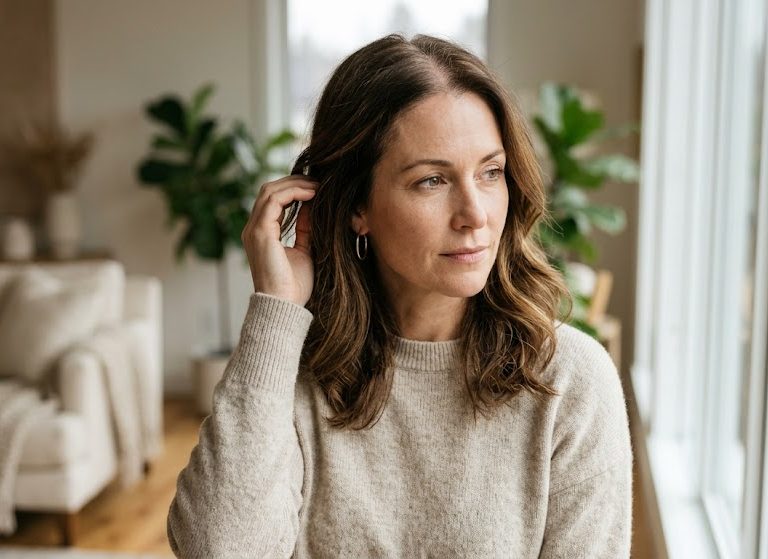
You already know it’s not just about the hair. But nobody around you seems to say that out loud. This article looks honestly at why hair loss lands so differently for women, the cultural pressures that make it harder, and what a lasting, natural-looking solution actually looks like. The cultural impact of female hair loss runs deeper than appearances: it reshapes how women feel seen.
Why hair loss feels like a different kind of loss for women
For centuries, a woman’s hair has been woven into her identity in ways that have nothing to do with vanity. Across cultures, it signals femininity, health, youth, and belonging. That’s not superficial; it’s deeply conditioned, passed down through everything from fairy tales to film.
When hair starts thinning, many women describe the experience as a slow erosion of self. Not just how they look, but who they are. The mirror becomes something to avoid. Social events feel like performances. A simple ponytail, once effortless, becomes an exercise in camouflage.
This is the cultural impact of female hair loss that rarely gets discussed plainly: it doesn’t just affect your appearance. It affects how safe you feel being seen.
The gap between how society treats men and women experiencing hair loss
Men losing their hair is a cultural cliché. There are jokes, yes, but also widespread acceptance and even admiration in some quarters. A shaved head on a man can read as confident, strong, deliberate.
A woman experiencing thinning hair gets almost none of that latitude. There is no equivalent cultural shorthand that says this is fine, this is normal, this is still attractive. Instead, women are quietly expected to fix it, hide it, or simply not bring it up.
That asymmetry matters. It means women sit with hair loss in a kind of private shame that men, broadly speaking, don’t face in the same way. The emotional burden is heavier precisely because society makes so little room for it.
Hair loss in women can stem from a wide range of causes: hormonal shifts, postpartum changes, thyroid conditions, stress, traction from years of tight styles, or hereditary thinning. The cause varies. The cultural pressure surrounding it doesn’t.
What women actually need from a solution
Most solutions on offer, whether topical treatments, supplements, or extensions, come with significant caveats. They work partially, temporarily, or not at all for many women. They also ask a lot: daily application, ongoing expense, constant maintenance, or the visible fakery that extensions can carry.
What women dealing with hair thinning consistently say they want is simpler: density that looks real, a scalp that doesn’t catch the light in that revealing way, and the freedom to stop thinking about it every morning.
Scalp micropigmentation for women addresses this at the root of the visual problem. Tiny deposits of pigment are placed along the scalp to replicate the appearance of hair follicles, creating the impression of fuller, denser hair, without touching the existing hair and without shaving anything. The hair stays exactly as it is. The scalp simply looks less exposed.
It’s a density procedure, and that distinction matters. This is not a shaved-head look. It’s a refinement designed specifically for women who want their existing hair to appear thicker and more abundant. Hair loss and femininity perception are central to why this approach resonates: it works with what’s already there rather than replacing it.
What to expect from the SMP process for women
Female density SMP requires a minimum of three sessions, with a fourth sometimes needed depending on the degree of thinning and how the scalp responds. Sessions are spaced apart to allow the pigment to settle and to refine the result with precision in subsequent visits.
Each session builds on the last. The first lays the foundational density. The second deepens and balances. The third, and fourth if needed, is where everything is refined and the result truly becomes yours. There’s no dramatic reveal after one appointment; the process is gradual, which is exactly what makes it look natural.
The outcome is long-lasting rather than strictly permanent. The pigment doesn’t wash away, but it does soften over time and can be refreshed. For most women, it means years of waking up without having to think about their scalp, which is, for many, genuinely transformative.
Reclaiming that ease, that sense of looking like yourself without effort, is where the real confidence lives. Not in a particular hairstyle, but in no longer organising your life around what your scalp might reveal.
Frequently Asked Questions
Why does hair loss affect women’s confidence more than men’s?
Society ties female identity and femininity closely to hair in ways it simply doesn’t for men. Cultural narratives, media, and long-held beauty standards mean that when a woman’s hair thins, it’s rarely experienced as just a physical change. It touches identity, perceived femininity, and how seen or hidden a woman feels in daily life.
What causes hair thinning in women?
Female hair loss has many causes: hereditary thinning, hormonal changes including pregnancy and menopause, thyroid conditions, prolonged stress, nutritional deficiencies, and years of tension from tight hairstyles. Often it’s a combination of factors. Identifying the underlying cause matters, but it doesn’t change the very real emotional and social impact that follows.
What is female density SMP and how does it work?
Female density SMP is a scalp micropigmentation procedure designed for women with thinning hair. Tiny pigment deposits are placed on the scalp to mimic the look of hair follicles, creating the visual impression of greater density. The existing hair is left completely untouched; nothing is shaved. It makes the scalp look fuller beneath the hair that’s already there.
How many sessions does female density SMP require?
Female density SMP requires a minimum of three sessions, and some women benefit from a fourth depending on the extent of thinning and how their scalp responds. Sessions are spaced to allow pigment to settle properly, with each one refining and deepening the result. The gradual process is what gives the finished look its natural, undetectable quality.
Is scalp micropigmentation a permanent solution for women’s hair loss?
SMP is long-lasting rather than strictly permanent. The pigment doesn’t wash away, but it does soften gradually over the years and can be refreshed as needed. For most women it means years of consistent, natural-looking density without daily effort. It won’t stop biological hair loss from progressing, but it reliably addresses how the scalp looks beneath existing hair.