
By Peggy Pliscott, SMP Artist at Precision Scalp
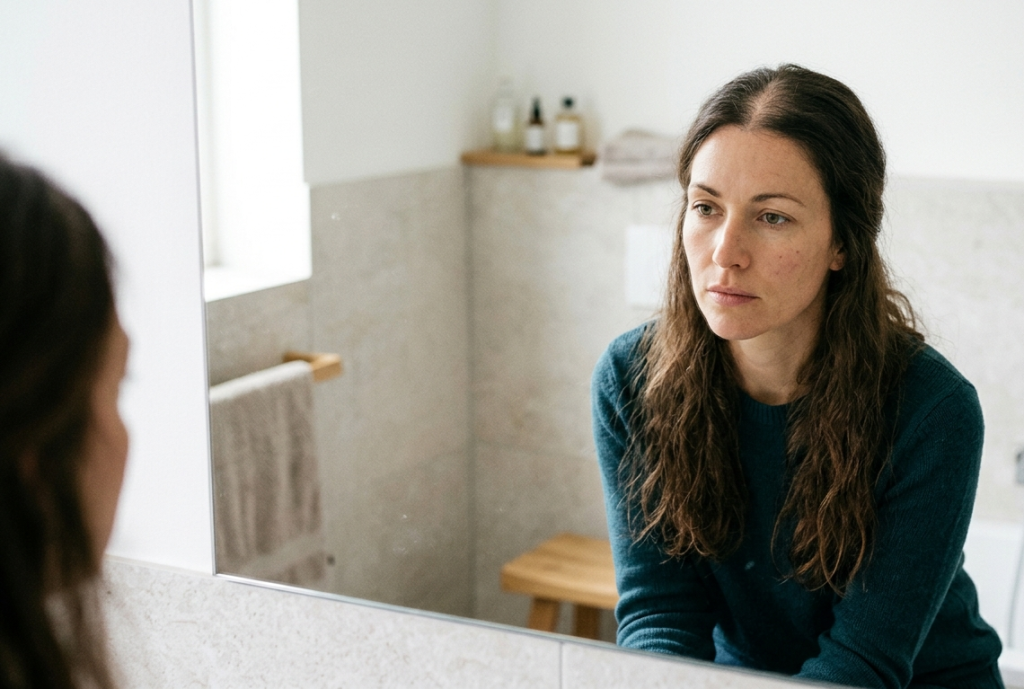
You notice it on the pillow, in the shower drain, in the harsh light of a bathroom mirror. For women, hair loss isn’t just a physical change: it cuts straight to identity, confidence, and how you move through the world. This article unpacks the real emotional weight behind thinning hair, what drives it, and what genuinely helps.
Why hair loss hits women so differently
The emotional impact of hair loss in women is measurably more severe than most people, including many doctors, acknowledge. Hair carries enormous cultural meaning for women. It signals youth, health, femininity, and vitality. When it starts to thin, the loss isn’t just cosmetic: it feels like something fundamental is being taken away.
Research consistently shows that women experiencing hair loss report higher levels of anxiety, depression, and social withdrawal than men facing the same condition. That’s not weakness. It’s a rational response to a culture that ties female worth to appearance far more tightly than it should.
The causes vary widely: hormonal shifts after pregnancy or menopause, thyroid conditions, iron deficiency, stress, autoimmune conditions like alopecia, and genetic thinning. Whatever the trigger, the psychological effects of thinning hair tend to follow a similar pattern. Hypervigilance about how your parting looks. Avoiding certain lighting. Pulling back from photographs. Cancelling social plans. Small erosions that accumulate into a quieter, smaller version of yourself.
The identity piece that gets overlooked
Women’s hair loss and mental health are deeply intertwined in ways that clinical language rarely captures. A woman who has always been known for her thick, glossy hair doesn’t just lose volume: she loses a part of how she has been seen and how she sees herself. That grief is real and deserves to be taken seriously.
There’s also a particular loneliness to it. Hair loss in men is socially accepted, even expected. For women, it’s still treated as something to hide, which means many suffer without saying a word. A 2023 survey found that over 60% of women with noticeable thinning had never discussed it openly with friends or family. That silence compounds the distress considerably.
Cultural pressure magnifies this further. From bridal imagery to red carpets to everyday advertising, full, lustrous hair is presented as the female default. When your reality diverges from that image, the gap between who you are and who you feel you’re supposed to look like can become genuinely destabilising.
What density SMP actually does for your confidence
Scalp micropigmentation for women, specifically density SMP, works by placing thousands of micro-impressions of pigment between existing hair follicles. It doesn’t touch the hair itself. There’s no shaving, no dramatic change to your style. What it does is create the visual impression of a fuller, denser scalp, so the contrast between hair and skin becomes far less stark.
The effect on confidence can be striking. When the thing you’ve been trying to hide is suddenly far less visible, the hypervigilance lifts. Women who’ve had density SMP often describe the change not primarily in terms of appearance but in terms of freedom: freedom to be in photographs again, to walk into a room without scanning for mirrors, to stop thinking about their hair every single day.
It’s worth being specific about what the process involves. Female density SMP always requires a minimum of three sessions, and sometimes four, depending on the degree of thinning and the result you’re aiming for. Sessions are spaced to allow the pigment to settle and the artist to build depth gradually. Rushing the process produces flat, unnatural results: patience is part of the craft.
Because density SMP is a highly individualised treatment, the artistry of the practitioner matters enormously. Pigment colour, placement depth, and dot size all need to complement your specific hair colour, skin tone, and pattern of thinning. Done well, it’s genuinely undetectable. Done carelessly, it isn’t. Choosing someone with a trained eye for proportion and colour is not a luxury: it’s the deciding factor between a result that looks natural and one that draws the wrong kind of attention.
Setting realistic expectations before you begin
Density SMP is not a hair restoration treatment. It doesn’t stimulate growth or replace lost follicles. What it does is visually address the most distressing symptom of thinning: the visible contrast between hair and scalp. For many women, resolving that one issue is enough to shift the entire emotional experience of their hair loss.
It also works best when your existing hair is long enough to sit over the treated scalp, which is why it suits women so well. The pigment blends beneath your natural hair rather than sitting exposed. Results are long-lasting but not permanent: a maintenance session every few years keeps the appearance consistent as pigment gradually softens over time.
If you’re also exploring other avenues, density SMP complements treatments like PRP therapy or topical solutions rather than competing with them. Some women use it as a standalone solution; others layer it alongside medical options. What matters is that it addresses the visible impact immediately, while longer-term treatments work in the background.
The most important shift, though, is the internal one. When you stop spending energy managing how your hair looks to others, that energy goes back to you: your work, your relationships, your presence. For many women dealing with the psychological effects of thinning hair, that’s not a small thing. It’s the point of the whole endeavour.
Frequently Asked Questions
Will density SMP look natural on women with fine or light-coloured hair?
Yes, when performed by an experienced artist. The key is precise pigment matching to your individual hair colour and skin tone, combined with micro-dot placement that mimics real follicle density. A skilled practitioner builds depth gradually across multiple sessions, ensuring the result blends seamlessly with your existing hair rather than creating obvious contrast.
How many sessions does female density SMP require?
Female density SMP always requires a minimum of three sessions, and some women need four depending on the degree of thinning and their desired result. Sessions are spaced apart to allow pigment to settle before the next layer is added. This staged approach produces a more natural, dimensional result than attempting to achieve everything in a single appointment.
Does density SMP work for all types of female hair loss?
Density SMP is effective for most patterns of female thinning, including diffuse thinning across the crown, a widening parting, and hair loss related to hormonal changes or genetic factors. It works by reducing the visible contrast between hair and scalp. It is not suited to areas of complete hair absence, where different approaches would need to be considered.
Can density SMP help with the psychological effects of thinning hair?
For many women, yes. The psychological effects of thinning hair often centre on hypervigilance about visible scalp contrast, avoidance of photographs, and social withdrawal. When density SMP reduces the visibility of that contrast, the constant mental monitoring tends to ease significantly. Many women describe regaining a sense of freedom and ease in social situations they had quietly given up.
How long do the results of density SMP last?
Results are long-lasting but not permanent. Most women find that pigment softens gradually over several years, at which point a maintenance session restores the original appearance. Factors including sun exposure, skin type, and aftercare habits all influence how quickly pigment fades. With occasional upkeep, the results of density SMP can be maintained indefinitely to suit your changing needs.