
By Peggy Pliscott, SMP Artist at Precision Scalp
You’ve decided shaved-style scalp micropigmentation is the right move. Now you’re searching for someone local you can actually trust with your head. This article breaks down exactly what to look for, which red flags to watch for, and what to ask before you hand over a deposit.
Why proximity alone is the wrong starting point
When you search for scalp micropigmentation near you, the results are full of options. The problem is that SMP is a specialised skill with no universal licensing body, which means almost anyone can advertise the service. Distance is convenient, but it should never be your primary filter.
What you’re really looking for is a practitioner whose technical background, artistic eye, and portfolio of healed results align with what you want: a natural-looking hairline, realistic follicle simulation, and work that still looks sharp six months after the appointment. That combination is rarer than the search results suggest.
Start by narrowing your list to practitioners who specialise in SMP specifically, not artists who offer it alongside a long menu of other cosmetic procedures. A focused practitioner accumulates the repetition needed to master scalp depth, pigment selection, and needle configuration. Generalists rarely do.
Credentials worth verifying before your consultation
There is no single national certification for SMP in the United Kingdom or internationally, but training lineage matters enormously. Ask directly where the practitioner trained and who taught them. Training with founding practitioners or established SMP-specific academies carries real weight. Vague answers about online courses or general tattooing backgrounds are worth probing further.
Beyond training, look for evidence of continued education. The pigments, equipment, and techniques used in scalp micropigmentation have evolved considerably. A practitioner who trained five years ago and stopped there is not the same as one who has updated their approach with current methods.
Also confirm that the clinic operates in a licensed facility with proper sterilisation protocols. This is non-negotiable for any procedure that breaks the skin. If a local SMP clinic cannot clearly answer questions about their hygiene standards, that is a hard stop.
How to read a portfolio the right way
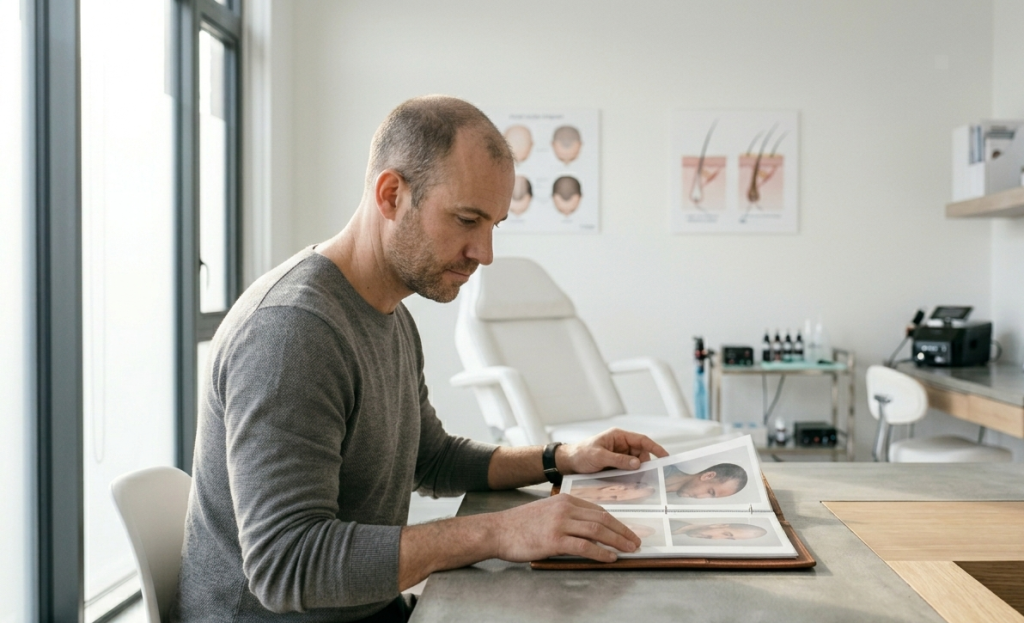
Every SMP practitioner will show you their best work. Your job is to look past the marketing images and ask one specific question: can I see healed results, not just fresh ones?
Fresh SMP looks dramatically sharp because the pigment is sitting in the skin before any settling occurs. Healed results, typically photographed four to eight weeks after the final session, tell you whether the dots retained their crisp, follicle-like appearance or blurred into grey smudges. Blurring is the most common quality issue with inexperienced SMP providers, and it is entirely preventable with proper technique and appropriate pigment.
Look for consistent dot size across the scalp. Uniform, small impressions that mimic the look of a closely shaved head are the goal. Irregular sizing, patchy coverage, or a flat grey wash across the scalp are signs the artist lacks control over their equipment or needle technique.
Skin tone variety in the portfolio also matters. A practitioner who has produced natural results across a range of complexions has the colour theory knowledge to match pigment to your specific undertones. Ask which pigments they use and how they mix them for different skin tones.
Questions to ask at your consultation
A quality SMP clinic will offer a consultation before any commitment. Use it. The right practitioner welcomes detailed questions; anyone who rushes you through a booking conversation is telling you something important.
Ask about hairline design specifically. For a shaved-style result, the hairline should look like a natural recession point, not a sharp geometric line drawn across the forehead. The best SMP artists work with your facial structure, your age, and your bone structure to place the hairline where it looks like it belongs.
Ask how many sessions the procedure typically requires. Shaved-style scalp micropigmentation is generally completed across two to three sessions, spaced roughly seven to ten days apart, allowing the skin to heal between each pass and giving the practitioner the opportunity to build realistic depth and variation.
Ask what happens if you’re not satisfied. A confident practitioner will have a clear, honest answer about their touch-up policy and what adjustments can be made after healing. Vague reassurances are a warning sign.
Finally, ask to see the space itself before you book. A professional clinic is clean, organised, and purpose-built for the procedure. The environment reflects how the practitioner approaches their work. If it feels like an afterthought, it probably is.
Finding the right scalp micropigmentation clinic near you takes more than a quick search and a glance at the first result. The practitioners worth travelling a little further for are the ones whose credentials are transparent, whose portfolios hold up under scrutiny, and whose consultation gives you confidence that they understand exactly what result you’re after and know how to deliver it.
Frequently Asked Questions
How do I find a qualified scalp micropigmentation practitioner near me?
Search for SMP-specific clinics rather than general tattoo studios, then verify training background, ask to see healed portfolio work, and book a consultation before committing. Proximity is useful but should never replace a thorough check of credentials, hygiene standards, and evidence of consistent, natural-looking results.
What credentials should an SMP artist have?
There is no single universal licensing body for scalp micropigmentation, so training lineage matters most. Look for practitioners who trained with established SMP academies or founding specialists, who operate in a licensed facility, and who can explain their sterilisation protocols clearly. Continued education after initial training is also a strong indicator of professionalism.
How many sessions does a shaved-style SMP take?
A shaved-style scalp micropigmentation is typically completed in two to three sessions, spaced roughly seven to ten days apart. This spacing allows the skin to heal between each pass and gives the practitioner the ability to layer pigment for realistic depth and variation before assessing the final result.
What should I look for in an SMP portfolio?
Always ask to see healed results photographed four to eight weeks after the final session, not just fresh work. Look for consistent, small dot sizes that replicate the look of a closely shaved head, and check whether the artist has produced natural results across different skin tones. Blurring or uneven sizing signals a technique or pigment problem.
Are local SMP clinics as good as specialist studios further away?
Sometimes, but not always. Local SMP clinics vary widely in quality because the industry has no universal regulation. A specialist studio with a strong healed portfolio, verified training, and a thorough consultation process is worth travelling to, even if it means going beyond the nearest result in your search. Credentials and artistic skill outweigh convenience.